
Old Age and Wisdom Part IV: Plato and Socrates Part 1
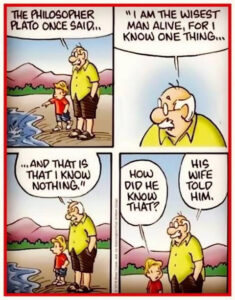
Several months ago, I attended a lunchtime lecture by Dr Kerry Sanders about Socrates and Free Speech.
She finished the lecture by recommending we read four dialogues known collectively as The Trial and Death of Socrates: Euthyphro, which sets the stage for the trial; the Apology, Socrates’ defence speech; Crito, where Socrates discusses escaping prison; and Phaedo, depicting his final hours and discussion on the soul before committing suicide drinking hemlock.
In this blog I will discuss the first two dialogues after summarising the lecture.
Socrates is extremely important to the idea of free speech. He made a habit of questioning powerful Athenians—politicians, poets, generals, and even religious authorities—about concepts like justice, virtue, and knowledge. His method (the elenchus) exposed contradictions in their beliefs, often humiliating them in public.
This mattered because:
- He treated no belief as beyond question
- He believed truth emerges through open questioning
- He accepted social consequences rather than self-censor
This attitude lies at the heart of what we now associate with free speech: the idea that truth and moral clarity require open dialogue, not enforced orthodoxy.
Unfortunately he made a number of enemies that resulted in him going to trial charged with:
- Impiety (not believing in the city’s gods)
- Corrupting the youth
Importantly Socrates was allowed to speak at his trial. He defended himself openly But he was still sentenced to death for the content and effect of his speech
This makes Socrates one of history’s earliest and clearest examples of a society punishing someone not for violence, but for ideas.
Socrates was crucial to free speech in three lasting ways:
- He showed how questioning authority is essential to truth
- His execution became a warning about democratic intolerance
- His moral courage made free expression a matter of conscience, not convenience
He didn’t invent free speech—but he gave it its most enduring martyr and method.
Euthyphro is a Platonic dialogue that explores the nature of piety (holiness) and the difficulty of defining moral concepts. It takes place outside the Athenian court, where Socrates is about to face trial for impiety, and Euthyphro has come to prosecute his own father for the death of a servant. Confident in his moral knowledge, Euthyphro claims that prosecuting his father is a pious act.
Socrates, professing ignorance, asks Euthyphro to explain what piety actually is. Euthyphro first defines piety as doing what he is doing now: prosecuting wrongdoers, even family members. Socrates rejects this as an example rather than a definition, asking for the essential feature that makes all pious acts pious.
Euthyphro then claims that piety is what is loved by the gods. Socrates points out that the gods often disagree, so the same action could be both loved and hated, making it both pious and impious. Euthyphro revises his definition: piety is what all the gods love. This leads to the central philosophical problem of the dialogue, the “Euthyphro dilemma.” Socrates asks whether something is pious because the gods love it, or whether the gods love it because it is pious. If the former, piety seems arbitrary; if the latter, piety exists independently of the gods’ approval.
Attempting again, Euthyphro suggests that piety is a kind of service or care for the gods. Socrates presses him to explain how humans benefit the gods through such service. When Euthyphro says it involves prayer and sacrifice—giving the gods what they like—Socrates shows that this reduces once more to the idea that piety is what pleases the gods, returning to the earlier, unresolved definition.
Unable to give a satisfactory account, Euthyphro abruptly leaves. The dialogue ends without a final definition, illustrating Socrates’ method of exposing false confidence and Plato’s view that moral understanding requires rigorous examination rather than unexamined tradition or religious authority.
Plato’s Apology presents Socrates’ defence speech at his trial in Athens in 399 BCE, where he is charged with impiety and corrupting the youth. Rather than an apology in the modern sense, the dialogue is a formal defence explaining and justifying Socrates’ life and actions.
Socrates begins by addressing the long-standing prejudices against him, especially the claim that he is a sophist who makes weak arguments seem strong and speculates about natural phenomena. He denies being a sophist or teaching for pay and explains that his reputation began with the Delphic oracle, which declared that no one was wiser than Socrates. Puzzled by this, Socrates set out to test the oracle by questioning politicians, poets, and craftsmen. He discovered that while they claimed knowledge, they often could not justify their beliefs. Socrates concluded that his wisdom lay in recognizing his own ignorance.
Addressing the formal charges, Socrates argues that he does not corrupt the youth intentionally, since harming others would ultimately harm himself. If any corruption occurred, it must have been unintentional and should have been corrected through instruction, not prosecution. On the charge of impiety, he points out the contradiction in accusing him both of atheism and of introducing new divine influences, since belief in spiritual beings presupposes belief in gods.
Socrates famously declares that he will continue practicing philosophy even if acquitted on the condition that he stop questioning people. He insists that examining oneself and others is a divine mission and that “the unexamined life is not worth living.” Philosophy, he argues, benefits the city by encouraging virtue rather than wealth or reputation.
After being found guilty, Socrates proposes a mock “punishment” of free meals for life, then reluctantly suggests a fine. When sentenced to death, he accepts the verdict calmly, reflecting on death as either a peaceful oblivion or a continuation of philosophical inquiry. The dialogue ends with Socrates affirming his commitment to justice and reason, portraying him as a moral exemplar who values truth over survival.
Finishing this blog These are my five favourite Socratic quotes:
“The only true wisdom is in knowing you know nothing.”
The unexamined life is not worth living.”
“Strong minds discuss ideas, average minds discuss events, weak minds discuss people.”
“By all means marry; if you get a good wife, you’ll become happy; if you get a bad one, you’ll become a philosopher.”
“The secret of happiness. is not found in seeking more, but in developing the capacity to enjoy less.”
The Temple at Delphi Has two famous inscriptions “Know thyself.” Usually attributed to Socrates
And “Everything in moderation.” Usually attributed to Aristotle.
Add Your Comment
Chris Golis - Author

"Put in a sales perspective, I loved your presentation! I got a lot from what you talked about and I will read your book."
Peter Morris, Executive Officer, Lomax Financial Group
Your presentation on 'Lifting your Level of Emotional Intelligence" to 10 CEOs scored an average 8.9 out of 10 for the topic and 8.5 for the presentation which is great. A couple of the attendees gave you a 10 out of 10, and the comments were:
- Great presentation. Very informative.
- Excellent presentation.
- made me think.
Christi Spring CEO Institute. - web www.ceo.com.au.
1 Comments