
Old Age and Wisdom Part IV: Plato and Socrates Part 2
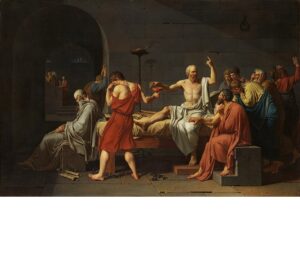
The Death of Socrates by Jacques Louis David
1f you have not read it please first read Old Age and Wisdom Part IV: Plato and Socrates Part 1
Crito
Plato’s Crito takes place in an Athenian prison shortly before Socrates is due to be executed. Socrates’ close friend Crito visits him at dawn, distressed that Socrates will soon die despite having the opportunity to escape. Crito urges Socrates to flee, arguing that staying will harm his friends’ reputations, deprive his children of a father, and represent an unjust acceptance of an unfair verdict.
Socrates responds calmly and refuses to be swayed by emotion or popular opinion. He argues that one should value justice and reason above life itself. The central question of the dialogue is whether it is ever right to commit an injustice in response to an injustice. Socrates firmly maintains that it is always wrong to do wrong, even if one has been wronged. Escaping prison would mean breaking the law, and thus committing injustice.
To support his argument, Socrates introduces the personified Laws of Athens, imagining them speaking directly to him. The Laws argue that by choosing to live in Athens, raising a family there, and benefiting from its legal system, Socrates has implicitly agreed to obey its laws. To escape now would be to break this social contract and undermine the authority of the law itself. The Laws claim that allowing individuals to disobey laws whenever they feel wronged would destroy the city.
Socrates also rejects Crito’s claim that public opinion matters, insisting that only the judgment of those who understand justice is worth considering. Living well, he argues, means living justly—not merely staying alive.
Ultimately, Socrates concludes that escaping would betray his moral principles and harm the very laws that shaped his life. He therefore refuses Crito’s offer and accepts his execution. The dialogue ends with Crito reluctantly accepting Socrates’ decision.
Crito explores themes of justice, moral integrity, obedience to law, and the tension between individual conscience and civic duty, reinforcing Socrates’ commitment to ethical consistency even in the face of death.
Phaedo
Plato’s Phaedo recounts the final hours of Socrates’ life and presents his most detailed arguments for the immortality of the soul. The dialogue is narrated by Phaedo to Echecrates and takes place in Socrates’ prison cell on the day of his execution. Although Socrates’ friends are distressed, Socrates himself remains calm and even cheerful, claiming that a true philosopher should not fear death.
Socrates begins by arguing that philosophy is a preparation for death. He defines death as the separation of the soul from the body and claims that the body is a source of distraction, error, and desire that interferes with the soul’s pursuit of truth. Philosophers, who seek knowledge of eternal and unchanging Forms such as Justice, Beauty, and Goodness, practice detachment from bodily pleasures and concerns throughout their lives. Death, therefore, allows the soul to attain pure knowledge.
Socrates then presents several arguments to show that the soul survives death. The first is the Cyclical Argument, which claims that all things come to be from their opposites; just as waking comes from sleeping, life must come from death, implying the soul’s continued existence. The second is the Theory of Recollection, which suggests that learning is remembering knowledge the soul possessed before birth, demonstrated by our ability to recognize abstract concepts like equality. This implies the soul existed prior to the body.
The third is the Affinity Argument, which holds that the soul resembles invisible, divine, and unchanging realities, while the body resembles visible, mortal, and changeable things. Since the soul is more like the eternal Forms, it is less likely to be destroyed at death. However, Socrates acknowledges that these arguments show the soul’s survival but not conclusively its immortality.
Later, Socrates introduces the Final Argument, based on the soul’s essential role as the source of life. Just as fire cannot admit cold, the soul cannot admit death, since it always brings life. Therefore, the soul must be immortal.
The dialogue concludes with a myth describing the afterlife, where souls are judged and rewarded or punished according to their moral character. Socrates emphasizes that belief in the soul’s immortality encourages a just and virtuous life. The Phaedo ends with Socrates calmly drinking the hemlock, exemplifying philosophical courage and commitment to reason until his death.
In conclusion these four books are an excellent introduction to Socrates and Plato. Socrates has many messages for us. The most important to me is “Know Thyself”. Firstly, find out your levels of IQ: General, Veral and Numerical. Secondly, discover your levels of the 7 EQ traits by doing this 5 minute quiz.
What happened to me is that when I googled Dr Kerry Sanders I dis covered she was about to start a 13 week online course Philosophical Themes in Homer – Iliad and Odyssey . So I signed myself up.
The Iliad is the longer book, so I started reading it first. It has 24 chapters and as of date of this blog I have read 18 and done the first 2 weeks of the 13-week course. When I complete the course I will blog about it.
Add Your Comment
Chris Golis - Author

"Put in a sales perspective, I loved your presentation! I got a lot from what you talked about and I will read your book."
Peter Morris, Executive Officer, Lomax Financial Group
Your presentation on 'Lifting your Level of Emotional Intelligence" to 10 CEOs scored an average 8.9 out of 10 for the topic and 8.5 for the presentation which is great. A couple of the attendees gave you a 10 out of 10, and the comments were:
- Great presentation. Very informative.
- Excellent presentation.
- made me think.
Christi Spring CEO Institute. - web www.ceo.com.au.
0 Comments